
When people hear the word “design,” they often think about drawing, painting, or making things look beautiful.
But design is much more than that.
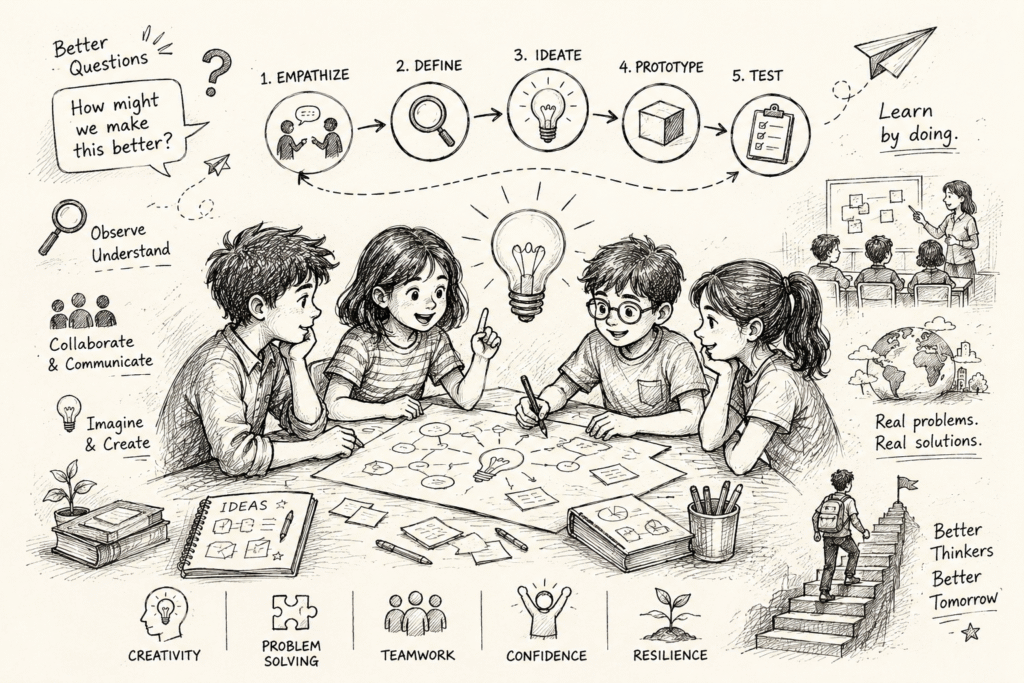
Design is a way of understanding the world, solving problems, and creating better solutions for people. This way of approaching challenges is called Design Thinking.
Today, educators around the world consider design thinking to be one of the most effective learning frameworks because it helps students become active learners instead of passive receivers of information.
What is Design Thinking?
Imagine that students in your classroom find it difficult to keep their desks organized.
Most people would simply accept the situation.
A designer asks different questions:
- Why does this problem exist?
- How do students feel about it?
- What solutions can we try?
- Which solution works best?
Students then come up with ideas, build simple solutions, test them, and improve them.
This process of understanding, creating, testing, and improving is called design thinking.
Why Design Thinking is One of the Best Educational Frameworks
Traditional education often focuses on finding the correct answer.
Design thinking focuses on asking better questions.
In many real-life situations, there is no single correct answer. Problems can be solved in many different ways.
Design thinking prepares students for this reality.
Instead of memorizing information, students learn how to:
- Observe carefully
- Ask meaningful questions
- Generate ideas
- Test their assumptions
- Learn from mistakes
- Work with others
- Improve their solutions
These are skills that students will use throughout their lives, regardless of the career they choose.
How Design Thinking Helps Children Learn Better
Most children learn best when they are actively involved.
Think about how a child learns to ride a bicycle.
Reading about bicycles is helpful.
Watching videos is helpful.
But real learning happens when the child gets on the bicycle and starts riding.
The same principle applies to education.
Design thinking encourages students to learn by doing.
When children work on real problems, they become more engaged and curious. They naturally ask questions, search for information, and experiment with ideas.
This makes learning more meaningful and memorable.
Students are not learning because they have to.
They are learning because they want to solve a problem.
Design Thinking Connects Different Subjects
One of the most powerful aspects of design thinking is that it connects different areas of knowledge.
Imagine students are trying to design a better school garden.
They might use:
- Science to understand plants
- Mathematics to measure space
- Language skills to present their ideas
- Art to sketch concepts
- Teamwork to collaborate with friends
Instead of learning subjects separately, students learn how different subjects work together in the real world.
Design Thinking Builds Confidence
Many students hesitate to share ideas because they are afraid of being wrong.
Design thinking creates an environment where exploration is encouraged.
Students learn that:
- Every idea is worth considering
- Feedback helps improve ideas
- Mistakes are part of the process
- Improvement is more important than perfection
Over time, this builds confidence and encourages students to take initiative.
Preparing Students for the Future
The future will belong to people who can think creatively, solve problems, communicate effectively, and adapt to change.
These abilities cannot be developed through memorization alone.
They are developed through practice.
Design thinking provides that practice.
It teaches students how to approach unfamiliar challenges, work with others, and create meaningful solutions.
These skills are valuable whether a student becomes a designer, engineer, doctor, teacher, entrepreneur, farmer, or scientist.
A Small Challenge
Today, look around your home or school and ask:
“How might we make this better?”
Choose one small problem.
Observe it carefully.
Talk to people affected by it.
Sketch a few ideas.
Test one of your solutions.
Congratulations.
You have just taken your first step into the world of design thinking.
Final Thoughts
Design thinking is not just a method used by designers.
It is a framework for learning, thinking, and solving problems.
It helps children become curious learners, creative thinkers, confident communicators, and thoughtful problem solvers.
More importantly, it teaches them that they have the ability to improve the world around them.
And that is a lesson worth learning.